The Gift That Opened Everything
The question I carry as a parent is whether curiosity still ignites in a world where the answers arrive before the questions are fully formed.
There is a question I keep circling back to as a parent. What kind of childhood produces a driven adult? Is it one where things are lacking - where the hunger to achieve is born from scarcity? Or is it one where everything is available - where the child can focus on meaning rather than survival?
I do not have the answer. But I have two data points. My childhood, and my son's.
I was born in 1988 and grew up in Lloret de Mar. My childhood was the 90s - Cartoon Network, the children's channel on satellite, and a house where technology was something you admired from a distance.
I remember one Christmas - I must have been five or six. There was a big box under the tree. I had been asking my parents for months to get our satellite connection back. We had lost access to the children's channel when our borrowed Sky viewing card expired. A friend of my parents in the UK had lent them one, and it only worked for a few months.
I was certain this box was a satellite receiver. I kept saying it. "It's the children's channel. It's the children's channel."
It was not the children's channel.
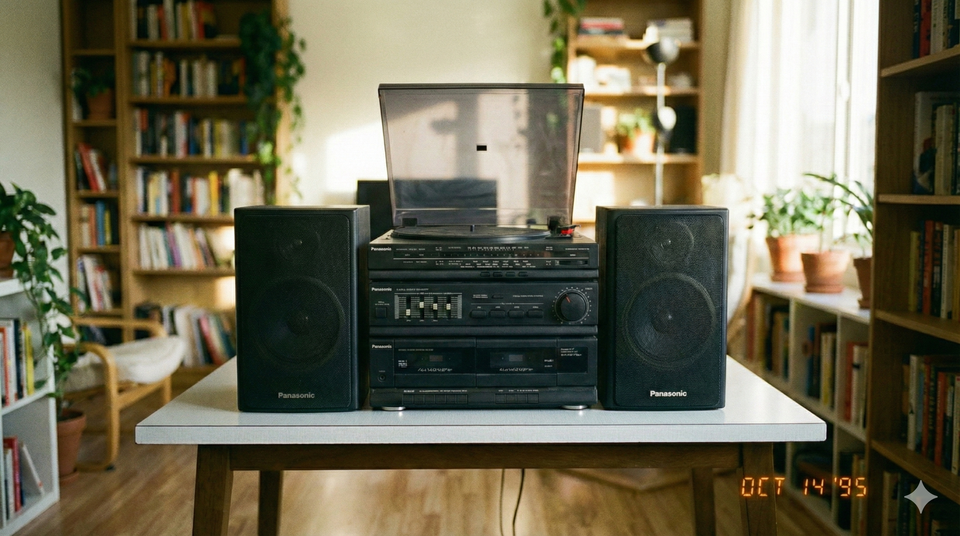
It was a music system - one of those integrated units. Cassette deck at the bottom. Tuner in the middle. Vinyl record player on top. Two speakers at either side. A proper piece of equipment for a five-year-old to receive.
The initial disappointment lasted about ten minutes. Then something else took over.
I became obsessed with that music system. I wanted to understand how it worked. I wanted to connect more speakers to it. My parents had old speakers lying around the house - mismatched, dusty, left over from other devices. I grabbed them all and wired them up.
My logic was simple: more speakers, more volume. Double the speakers, double the sound.
My father told me it does not work like that. I asked why.
That question - why - sent me down a path that lasted years. By the time I was nine or ten, I had taught myself about resistance levels. 4 ohms versus 8 ohms. What happens when you chain speakers together. The fact that you need an amplifier to drive them. The wattage dictates the power. It does not matter how many speakers you connect to the same amplifier - the power stays the same.
I did not know it at the time, but that one gift was an early education in electronics, in power, in how things work. It opened a door that led to everything I built afterwards.
By twelve or thirteen, I had constructed a mini disco in my bedroom. Coloured light bulbs screwed onto a pole. A relay system that controlled the lights. I programmed the relay to accept audio input from an old Yamaha keyboard with a built-in drum machine. The frequency of the signal pulsated the lights. I had a light show running off a keyboard and a relay system.
I got electrocuted a few times. It was worth it.
My son turns eight next week. His childhood looks nothing like mine.
He got his first iPhone when he was two - not to watch YouTube, but to play games and learn how the device worked. It was an old phone of mine that happened to still have an active SIM card. That SIM is now his number.
He started on YouTube Kids, which provides safeguarded content for younger children. Around six, when he got into Roblox, he and his friends started watching gaming videos on the main YouTube app. He asked if he could switch. I agreed, with boundaries: mostly long-form content, and he should try to learn something from what he watches rather than consuming it purely for entertainment.
The problem I now face is that the YouTube algorithm pushes shorts relentlessly. You cannot use the app without being served short-form content. I have not found a way to disable it. And he is watching more shorts than I would like.
I am aware of what is coming. Instagram. TikTok. Platforms that make YouTube shorts look restrained. I cannot police what he watches every minute of the day. All I can do is hope that the framework I have given him - the ability to distinguish between content that teaches and content that numbs - holds when I am not in the room.
When I was a child, brain rot was the children's channel. That was it. The internet did not exist. If I wanted to learn something, I had to open the physical encyclopaedia and hope the entry covered what I needed.
Now, brain rot is infinite. YouTube shorts. TikTok. Split-screen videos where one side shows facts and the other side shows someone cutting wood - two entirely separate topics designed to double the retention factor. The people creating these videos are not interested in providing value. They are interested in attention. Attention is the currency. YouTube pays for it. The incentive is retention, not education.
This means the content my son is exposed to is not vetted for quality. It is optimised for dopamine. And the quantity of it in production right now compared to what existed in the 90s is staggering.
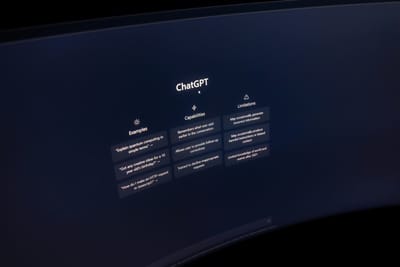
And then there is AI. My son uses ChatGPT almost as much as I do. He asks it questions about everything. He gets answers immediately - articulate, confident, detailed answers.
This raises a question I think about often. If the answer to everything is a prompt away, what happens to the work ethic of learning? Is there a need to retain information? Is there a need to know what the capital of Uganda is when you can ask a machine and get the answer in a second?
I think there is. Knowing things - geography, history, how the world works - gives you a lens to view the world through. Your own lens. Not one filtered through an AI that assembles an answer from patterns in data. The danger is subtle: kids do not know that AI makes mistakes. The answers sound confident. Confident-sounding answers feel correct. But ask ChatGPT how many Rs are in "strawberry" and you will see that machines make errors humans do not.
On the other hand, if ChatGPT and YouTube had existed when I was a child, I cannot imagine what I would have done with it. The access to information. The ability to learn anything, immediately. The sheer volume of opportunity. I would have tried different things, explored different ideas, possibly built different things entirely. Or maybe I would have just asked the AI to build it for me, and never learned how anything worked. It is an interesting conundrum.
The final piece I keep turning over is money.
I grew up in an environment of slight scarcity. We were not in need, but we were not well off. I remember my father picking me up from school in a 1988 Volkswagen Golf when it was 2002 or 2003. A fifteen-year-old car. My friends at school called it a coffee machine. I was a little embarrassed, but my dad was proud of it. Deep down, I thought it was a good car. Old, but good.
When it was finally time to replace it, my father looked at an Audi A3. Too expensive. He went with a secondhand Seat Leon instead. He still has that car today, twenty years later.
My family never splashed money. We were conservative. Maybe it is the Catalan in him - there is a custom, rightly or wrongly attributed, of Catalans being careful with money. Or maybe it was simply that abundance was never available.
The one time my father did spend freely was in 2008, when his business had a strong year. I had always wanted a recording studio. We spent maybe fifteen or twenty thousand euros converting the top floor of our house - soundproofing, equipment, the lot. The timing was imperfect because I moved to the UK that same year. But the studio got built.
My parents never bought me a Game Boy. Never bought me a game console. I never asked twice because I was already occupied - connecting speakers, building light shows, experimenting with electronics.
And that brings me to the question that sits underneath all of this.
If you are brought up in an environment where nothing is lacking, does it make you hungry? Does it drive you to achieve? Or does it make you comfortable - content with what is available because effort was never required to obtain it?
I have seen both outcomes. Friends whose parents had money but did not give enough attention. Those friends have not achieved much with their lives. They are not worried about it either. That is the part that concerns me.
We are here to make an impact. To leave something behind that mattered. If we do not achieve that - if we do not improve the lives of the people around us in some meaningful way - what was the point?
That is what gives me meaning. But will my son share it? Will the presence or absence of financial pressure shape whether he develops the drive to build something of his own?
I do not know. Nobody does.
What I know is that a five-year-old boy opened a music system on Christmas morning and spent the next decade learning how sound, electricity, and engineering worked - not because anyone told him to, but because the curiosity was there and the constraints forced him to figure it out.
The question I carry as a parent is whether curiosity still ignites in a world where the answers arrive before the questions are fully formed.
Become a subscriber receive the latest updates in your inbox.