AI is no longer a single chatbot but a layered stack of thinking, building, doing, and creative tools, and once you understand that map, choosing the right tool for your business becomes obvious.
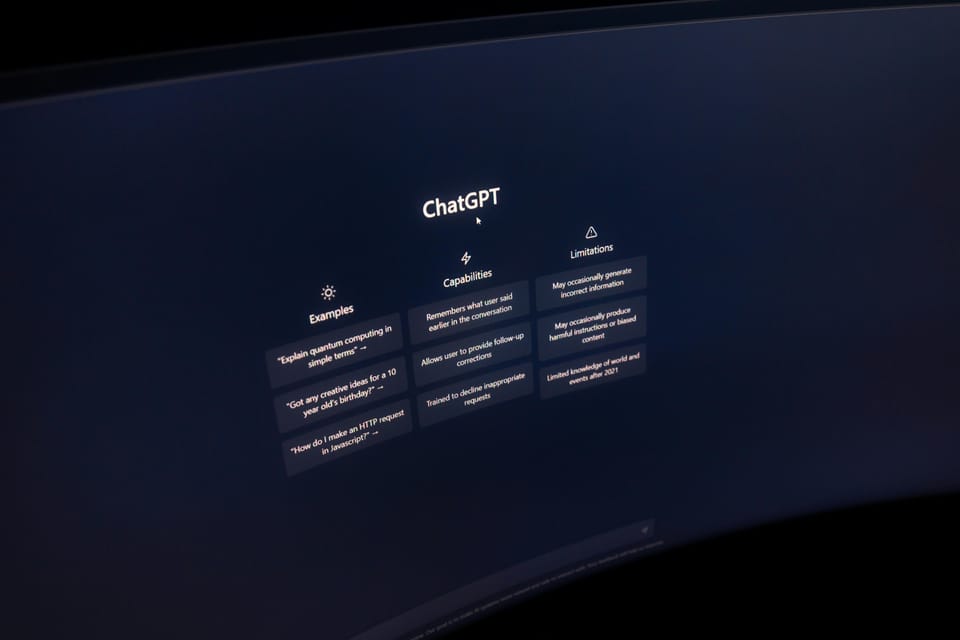
ChatGPT, the AI tool that kicked this all off on 30 November 2022
I get some version of this question almost every week from founders and business owners: "What AI tool should I actually be using?"
Two years ago the answer was simple. ChatGPT. That was it. Start there.
Today the honest answer is: it depends what you are trying to do. Because the landscape has fractured into something much more interesting - and much more useful - than a single chatbot. There are now distinct layers to the AI world, each built for a different kind of work. Once you understand how those layers map together, the noise disappears and you can start making smart choices about where AI fits into your business.
Here is my attempt at a clear-headed overview of where everything stands in early 2026.
The Thinking Layer: Chat Models
These are the tools most people mean when they say "AI". You type something in, they respond. They can answer questions, draft documents, summarise information, help you think through a problem, translate, analyse, and much more.
The main ones worth knowing:
ChatGPT (OpenAI) - The one that started it all. Now on GPT-5. Still the default starting point for most people and for good reason - it is capable, versatile, and has the widest range of integrations. If you only use one tool, this is still a reasonable choice.
Claude (Anthropic) - My preferred tool for anything involving nuance, long documents, or careful reasoning. It handles large amounts of text particularly well and the responses tend to feel more considered. It is also the model that powers Claude Code, which is what I use for building software.
Gemini (Google) - Google's model, and it is genuinely excellent. Deep integration with Google Workspace means if your business runs on Google Docs and Gmail, Gemini is worth paying serious attention to. It will shortly become the engine behind a revamped Siri, following Apple and Google's recently announced partnership.
Grok (xAI) - Elon Musk's model. Good for current events, strong on real-time information if you are on X (Twitter). Useful if you want a less filtered perspective on things.
Perplexity (Sonar) - Less of a chatbot, more of a research engine. It searches the web, cites its sources, and gives you factual answers with references. If you need to research a topic quickly and trust the results, Perplexity is excellent.
The honest truth about all of these: the gap between them is narrowing. Two years ago ChatGPT was clearly ahead. Today they are all capable. The differences come down to specific strengths, interface preferences, and integrations. Do not spend weeks agonising over which is "best". Pick one, use it daily, and your instinct for when to try a different one will develop naturally.
There are also a handful of others worth being aware of - Llama (Meta's open-source model, free to use), Mistral (French company, good for European data privacy requirements), and DeepSeek (Chinese model, impressive capability at low cost) - but for most founders these are secondary considerations.
The Enterprise Layer
Beyond the consumer chat tools, several models are built specifically for businesses and platforms.
Microsoft Copilot is built directly into Microsoft 365 - Word, Excel, Outlook, Teams. If your business runs on Microsoft, it is worth exploring. In terms of raw capability it is largely built on OpenAI's technology, so the intelligence is familiar. The value is the integration.
Amazon Nova integrates natively into AWS. If you run applications on Amazon's cloud infrastructure and want AI capability inside those applications, Nova removes the need to call external APIs. For developers building on AWS, this matters.
Cohere builds models for businesses that need AI embedded into their own products - think a company that wants to search through its own internal documents intelligently. Their technology converts text into numerical patterns that a computer can search through by meaning, not just keywords. Relevant if you are building a product that needs that kind of capability.
Apple: The Interesting Exception
Apple's situation deserves its own section because it says something important about where AI is heading.
Apple entered the AI race with "Apple Intelligence" - an on-device model focused on privacy. The pitch was that your data stays on your device rather than travelling to a server somewhere. A good idea in principle.
The problem is the delivery mechanism: Siri. And Siri is, to put it plainly, not good. Compared to what Google Assistant or ChatGPT can do, the gap is significant. Apple has lost ground here, and recently confirmed it by announcing a partnership with Google to power the next generation of Apple Intelligence with Gemini models.
There are two ways to read this. Either Apple has been left behind and is outsourcing the hard problem. Or - and this is the argument I find more convincing - Apple is doing what Apple has always done: waiting for the market to mature, then using its advantage (the device, the interface, the integration, the trust) to deliver a superior experience on top of a commoditised engine.
The second argument points to something true about where AI is heading. The model itself is becoming less important. The experience around the model is what will matter.
The Building Layer: Coding Tools
This is the area I have personal experience with and it has moved faster than almost anything else in AI.
I remember using GPT-3.5 for code. It was rough. Useful for small problems, unreliable for anything serious. GPT-4 was a meaningful step forward. Then something shifted.
When I switched to Claude Code - Anthropic's purpose-built coding tool - the quality of the code being generated was, in my experience, roughly five to ten times better. Not a small improvement. A fundamental change. The reasoning was more accurate. The code actually worked. The back-and-forth felt more like working with a capable developer than prompting a machine.
There are now two broad paths for founders who want to build something with AI:
Purpose-built tools (Bolt, Replit, Lovable, V0 and others): You go to a website, describe what you want, and start building immediately. No server setup. No technical knowledge required. These are excellent for getting an idea off the ground quickly. The limitation is cost - serious usage burns through credits fast - and control. If you want to build something substantial and scalable, you will hit ceilings.
Raw coding tools (Claude Code, Cursor, Codex): You write and edit code directly, with AI assisting the process. More setup required. You need to think about where your code lives and how it gets deployed. But the control is orders of magnitude greater and the long-term economics are much better.
OpenAI also has a tool called Codex worth knowing about. I ran an experiment: I gave the same detailed product specification to both Codex and Claude Code simultaneously. Claude Code came back within ten minutes with a base structure that needed significant further development. Codex spent three to four hours building - on its own, without any back-and-forth - and came back with something considerably more developed. I used Codex's output as the foundation and then continued building with Claude Code for day-to-day development.
If you are building a serious application, my recommendation is Claude Code or Cursor for ongoing work. Codex is worth knowing about for the initial heavy lift.
Tools like Devin and Manus operate at a higher level still - they are AI agents specifically built for engineering tasks. Devin is particularly good at structured, clearly defined work. Manus is more of a generalist agent that can handle a wider range of knowledge tasks beyond just coding. Both are impressive. Neither has yet achieved the mainstream adoption of Claude Code for day-to-day use.
The Doing Layer: Agents
This is where things get genuinely interesting - and where most founders are underestimating what is coming.
An AI agent is not a chatbot. A chatbot responds to questions. An agent does things. You give it a goal, it breaks that goal into smaller tasks, executes them - often in parallel, often across multiple tools - and delivers a finished output.
The clearest practical example: Claude Cowork, launched in January 2026, lets you give Claude access to a folder on your computer and describe an outcome in plain English. It then reads files, creates documents, organises folders, cross-references information, and delivers finished work. Not a draft. Actual finished work. In a test, it reorganised a 500-file Google Drive, created logical folder structures, renamed files consistently, and flagged duplicates in under ten minutes. A task that would have taken several hours manually.
ChatGPT's equivalent, Agent Mode, launched four days later. Its approach is different - rather than working with local files, it gives ChatGPT access to a virtual computer in the cloud where it can browse the web, fill in forms, book things, and execute tasks across multiple websites.
The practical distinction: if your work involves files and documents, Claude Cowork is ahead. If your work involves web-based tasks, ChatGPT Agent Mode is stronger.
Google's version, called Project Mariner, runs as a browser extension and can handle multiple tasks simultaneously. One distinctive feature - you can demonstrate a workflow to it once and it learns to repeat it. Useful for recurring tasks.
Underlying all of this is an open standard called MCP (Model Context Protocol), introduced by Anthropic in late 2024. Think of it as a universal connector - like USB-C, but for AI. It allows any AI model to connect to any external tool (your calendar, your CRM, your database, your files) without custom coding for every connection. This is the infrastructure layer that makes agents genuinely useful rather than isolated demos.
The shift from "AI answers questions" to "AI does work" is not incremental. It is a different category of tool.
The Creative Layer
A brief tour through the areas beyond text and code:
Images: Image generation has matured significantly. All the major chat models now generate images competently from a good prompt. Specialist tools like Midjourney remain strong for high-quality creative work, but the barrier to entry for business use cases is essentially gone.
Voice: This is moving quickly. Companies like ElevenLabs, Vapi, and Cartesia are building voice AI that sounds increasingly human. The combination of voice AI with tool connections (via MCP) means you can now have a spoken conversation with an AI that can take real actions - booking appointments, updating records, managing calls. This is why we are building Ringup into We UC: a voice AI layer that allows our customers to create call flows combining human agents and AI agents, without stitching together third-party systems.
Music: Suno has been the category leader for AI music generation. ElevenLabs, primarily a voice AI company, has entered the space and the quality of what they produce is genuinely impressive. AI-generated music is already appearing at scale on YouTube and Spotify. Artists are using AI to produce music in styles and genres they would not typically work in.
Video: Consumer video generation has arrived. Sora 2 (OpenAI) generates up to 20-second clips and can incorporate your own face and likeness. Google's Veo 3 is similarly capable. Tools like Kling and Pika do strong image-to-video animation. For more professional work, Runway offers editorial control and character consistency. For production-level work, tools like ComfyUI (used by VFX studios), Autodesk Flow Studio, and Topaz Video AI handle the complex tasks. About 70% of films now involve AI tools at some stage of production.
What This Means
The picture that emerges is not chaos. It is a stack.
At the base: thinking tools (chat models) for reasoning, drafting, analysis. Above that: building tools (coding AI) for creating software and automations. Above that: doing tools (agents) for executing multi-step work autonomously. Alongside all of it: creative tools for images, voice, music, and video.
The question is not "which AI tool should I use?" The question is "which layer of work am I trying to accelerate?" Once you frame it that way, the right tool usually becomes obvious.
The founders who understand this map will make better decisions faster than those who are still treating AI as a single thing. That gap is widening every month.
If you want my framework for running a founder and CEO business at full capacity, it is free at axelmolist.com/ceo-os.
Subscribe to our newsletter.
Become a subscriber receive the latest updates in your inbox.
You might also like
Feb 21
The Gift That Opened Everything
The question I carry as a parent is whether curiosity still ignites in a world where the answers arrive before the questions are fully formed.
6 min read
Feb 17
The Future Is Already Here
The cost of energy, software, and services is trending toward zero. Here is why that changes everything, and what it means for the future of technology.
6 min read
Jan 26
Motivation Is Perishable
My father could build anything, as long as the motivation lasted. This piece reflects on what he finished, what he didn’t, and how that shaped the way I think about timing, momentum, and starting before the urge fades.
4 min read
Jan 11
Microsoft Has Never Been For Me. We're Switching Anyway.
I avoided Microsoft for 20 years. We just switched 119 people to Microsoft 365.
Not because Microsoft got better. Because simplification matters more than preference at scale.