The Invisible Line Between Vibe Coding and Professional AI Coding
Vibe coding is for prototypes. Professional AI coding is for production. The line between them is invisible to most founders, until something breaks.


Last week I got on a call with a customer who'd built a working app for his business in a week. When I asked him what database it was running on, he didn't know.
That's vibe coding.
And there's a line, currently invisible to most people, between vibe coding and what I think of as professional AI coding. Same tools on both sides. The code can look identical on the surface. The difference doesn't show up until something breaks. And by then, it's usually too late.
I'm running a 20-person dev team at We UC, our unified communications platform. I founded circle.cloud, the telecoms business behind it. I spend most of my days either building software with AI or watching my customers try to do the same, and what I'm seeing is a line forming between two completely different disciplines. One side is genuinely transformative for small businesses. The other side is a time bomb waiting to go off in production.
This post is about where that line sits, and which side of it your business needs to be on.
Back to that phone call.
The guy on the other end of the video call runs a commercial refurbishment business. He fits out schools, hospitals and offices. His biggest operational headache was managing contractors. Sending out jobs, collecting quotes, tracking documents. The off-the-shelf tools were either too generic or required four separate products duct-taped together.
So he opened Claude Code and tried to build the thing himself.
He isn't a developer. His background is in web design, so he knows Figma and Photoshop. He knows what good user experience looks like. He doesn't know software engineering.
A week later, he had a working app; with login, contractor onboarding, job offers & bidding for his contractors, document uploads, messaging, everything he needed for a v1.
That's when I asked the question.
"What database are you using?"
He paused. Then logged into Vercel to check. Came back and said Supabase.
That's pure vibe coding. He'd built an app, and he had no concern about the architecture or the infrastructure. The AI was handling all of it, and for his internal use case, that was fine. It's brilliant, in fact. Five years ago, this person couldn't have built a single screen of that app, let alone the whole thing. Now he's solving a real operational problem in his own business in a week.
But if he ever opens that app to real customers, or starts holding data that matters, he's going to find a line he didn't know was there.
Vibe coding is the practice of describing what you want and accepting what the AI gives you. The AI picks the database and the infrastructure. The person vibing doesn't need to know any of it. For an internal tool sitting behind a corporate network or Cloudflare Access, that's a perfectly reasonable trade-off.
Professional AI coding is something else. The AI still writes the code, but before it writes a single line, three things have already happened.
Not an agile user story on a Post-it note. A proper product requirements document, paired with a technical spec. It explains, in the least ambiguous way possible, what the software does, why it needs to exist, how it integrates with other systems, what it doesn't do, and every edge case you can think of.
The best test I can think of is this: if you handed those documents to three separate engineers in isolation, they should all build roughly the same thing. If the spec leaves more room for interpretation than that, it isn't tight enough.
The db, data structure, API endpoints, security, whether there's a queueing system or message bus like RabbitMQ or Apache Kafka in the mix, etc.
These aren't handed off to the AI agent. They're handled by a professional who understands what those choices will cost six to twelve months down the line, when your customer base has grown, the product has evolved, and a design decision made in week one is suddenly the bottleneck.
You feed in your docs, and instead of letting the model start coding straight away, you ask it to come back with its implementation plan first. It should return something like: "Here's what I understood from your request, and here's what I'm going to build." A human then reads that plan and confirms it's correct before any code is generated.
The AI is the muscle. The human is the brain.
That's the line. Everything else is a consequence of it.
Same AI tools on both sides. The code may even look similar at first glance. The difference is invisible on the surface until something breaks.
At We UC, we're in the middle of building a serious upgrade to our analytics module. Custom dashboards, with the option to pull data from external sources. Effectively a mini BI tool built into the platform. Because of what we've learned, we're approaching this one very differently from how we've built things before.
First, we've written a properly detailed PRD. What the module does, why it exists, how it integrates, what it explicitly doesn't do, every edge case.
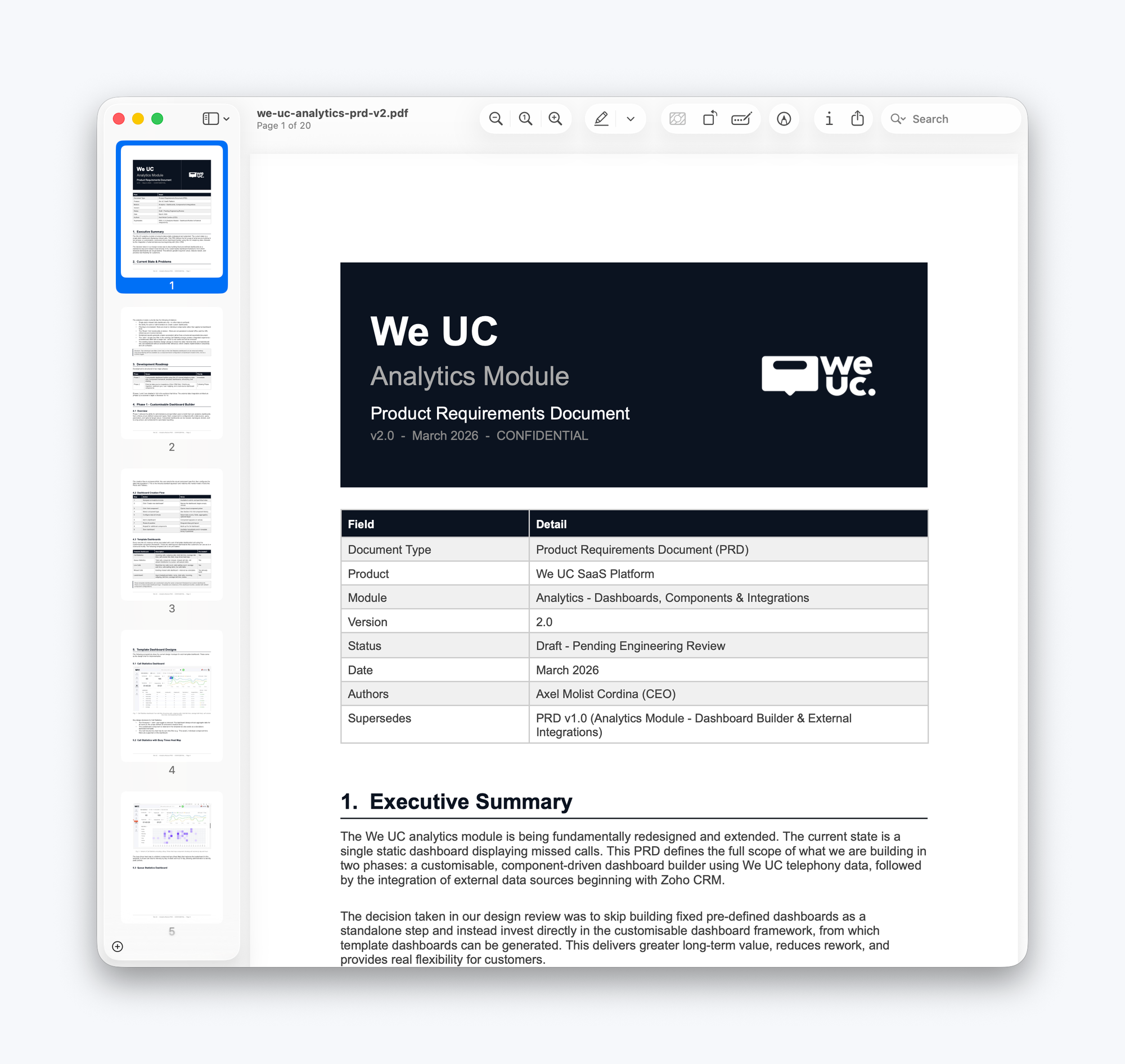
Second, our lead software architect is writing the technical specification. Data models, API contracts, state diagrams, error handling. The things AI coding tools aren't qualified to decide on their own.
Third, we'll use Claude Code to actually generate the implementation. With the architecture documented and the spec unambiguous, the AI should be able to handle that part with discipline.
There's a fourth idea I want to test as part of this project. I've been calling it an "anti-ambiguity agent". The idea is simple: we feed our documentation into a sequence of agents whose job is to look for ambiguity in the spec. Anything unclear comes back with a short list of possible interpretations, and our architect either picks one or proposes a better alternative. The output is a specification so unambiguous that whatever writes the code has no room for doubt.
It's slower to start than vibe coding. The PRD takes time. The spec takes time. The back-and-forth with the architect takes time. But once the foundation is in place, the AI moves fast, and the code that comes out is something we can actually deploy to paying customers.
The other phone call I had recently was with a dentist. Not my dentist, a customer of ours. He owns two dental practices, but between them they do the patient volume of five, because he's automated most of the usual admin away. His whole thing is business efficiency through technology.
And he'd hit the same problem as the refurb guy. He wanted a single piece of software that did exactly what his practices needed. The only off-the-shelf answer was to stitch together four or five different subscriptions.
So instead, he built the thing himself. A CRM with lead tracking and marketing. A finance dashboard that integrates with Dentally. A built-in learning management system. All in one platform, running production-quality code. He isn't doing it solo. He hired a developer with about ten years of experience who's now all-in with AI coding. Together they wrote the documentation first, then fed it into Claude Code. Eight weeks later, they've got a working prototype, and he's planning to launch it as a SaaS to other dental practices.
This isn't a one-off. Right now at We UC, we've got three open integration requests from customers who've either built their own custom CRM from scratch or are in the middle of doing it. Three, just from our own customer base. People who, a few years ago, would never have imagined themselves building software at all.
This is the thing I want small business owners and founders to understand. It's happening everywhere, behind the scenes, inside ordinary SMBs. Every one of those founders is going to run straight into the vibe-versus-professional line at some point. Usually the moment they sign up real customers, or something breaks under load, or they need to add a feature the prototype can't support.
There's a useful framework from Dan Shapiro that maps this territory. He describes five levels of AI coding, running from "spicy autocomplete" at level zero to what he calls the "dark factory" at level five, where software is generated fully autonomously from specifications with no human in the writing loop. A company called StrongDM claims to be operating at level five already. They only hire developers who don't write code.
Most dev teams I talk to are sitting at level zero or one without realising it. Most vibe coders, meanwhile, are actually operating somewhere around level four, writing specifications in plain English and directing the AI without ever touching the code. The gap isn't the level of autonomy. The gap is engineering discipline.
I'm not anti-vibe-coding. I vibe code things on the side for fun. I love it. It's a genuinely useful skill for prototypes, internal tools and low-stakes builds.
But if your business is shipping software to real customers, or holding data that matters, or running on the assumption that more users will join next month, vibe coding alone will eventually bite you. The foundation simply isn't built for the weight you're going to put on it.
The businesses that win with AI coding over the next few years will be the ones that recognise this line early, and plan the transition from vibe coding to professional AI coding before it's forced on them by an outage or a security incident. That transition is exactly what we're working through at We UC, piece by piece, starting with the analytics module.
Vibe coding is for prototypes. Professional AI coding is for production.
The line is almost invisible right now. The founders who learn to see it will ship better software, for longer.
Be one of them.
The video version of this drops on YouTube tomorrow. Same content, different format. If you're not subscribed to the channel already, that's where to find it: youtube.com/@axelmolist.
If running a business through the AI transition is on your plate, I also wrote The CEO Operating System, the framework I use to run multiple companies without burning out. It's free. axelmolist.com/ceo-os
Got thoughts, pushback, or a story of your own on this? Hit reply. I read every email.
Thanks,
Axel.
Join 480+ founders and operators getting my learnings from building and running my companies, straight to your inbox.