What you missed at the AI Summit Barcelona 2026
Over 10,000 people went to AI Summit Barcelona 2026 to work out how to use AI. The hardest problem there wasn't the AI.

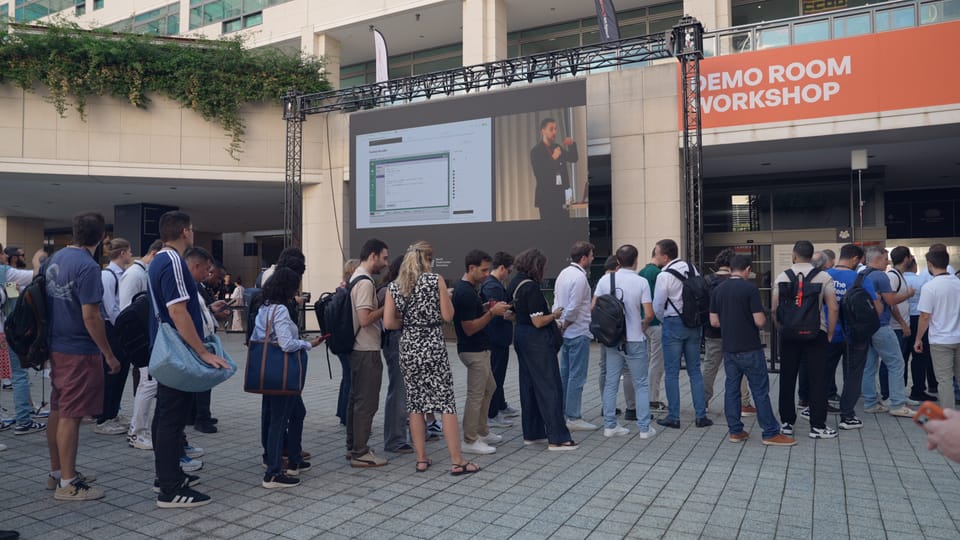
Last year, around 1,500 people went to the AI Summit in Barcelona. This year, the organisers put the number at over 10,000. You can probably guess how that went.
I went along. Ten thousand people, all trying to work out the same thing: how do we actually use AI in our businesses?
The most useful answer I got didn't come from a stage. It came from Carlos, the AI lead at a multinational company, a supply chain consultancy, in between two queues. He told me the hardest part of his job isn't the technology. It's the people.
Here's what was on stage, the two conversations I had off it, my honest verdict on the event, and what I think is really going on. Because we're living through it inside my own companies right now.
This was the second AI Summit Barcelona, held on 22 and 23 September at the World Trade Center, right on the port. Over 200 speakers and more than 160 sessions, with NVIDIA, Google, OpenAI and Anthropic on the bill.
I went because I built circle.cloud, a telecoms business, and we've just launched our own phone system, Olatti. I wanted to hear how everyone else is getting AI into their business.
I'll be honest, though. I didn't get into half the sessions I wanted to see, and I'll come back to why. So afterwards I went through the whole agenda, every entry, and four things kept coming up.
About one in five sessions was about this: 33 of the 169 agenda entries mention pilots, production or proof of concept. The titles say it outright, from "Beyond the Pilot" to "the Model Is the Easy Part".
Getting AI to work in a demo is easy now. Getting it to work every day, with real people, is the hard bit.
More than a third of the session descriptions mentioned agents. And my favourite title of the whole event was Tyler Foster's keynote: "Your user is asleep at 3am. What is your agent allowed to do?"
I didn't hear that talk, but the title alone says a lot. A demo always has someone watching it. A real product has to decide what to do when nobody's there.
This is AI that answers the phone. I've spent my career in telecoms, so these were the sessions I really wanted to see. I didn't get into a single one. The queues.
The big one on the agenda was Conforama, the furniture retailer. According to their session, they replaced an outsourced call centre with an AI voice agent and a small in-house team, and went from 30,000 calls a month to more than 100,000, across the phone, WhatsApp and the web, in nine languages. Those are their numbers, not mine, and I wasn't in the room.
This is the one that surprised me. Session after session on that agenda said the problem isn't the AI. It's the people. One keynote was literally called "Everyone Is 10x. The Company Isn't."
And it's exactly what I heard off stage too.
In between the sessions, and the queues, I got talking to people.
The first was Carlos, the AI lead I mentioned at the top. I asked him what the hardest part of his job is. He said the testing, the MVPs and the proofs of concept are easy. Scaling them across a big organisation, while keeping security and governance in place, is where it gets tricky. Then he put it like this:
"Models, AI, tools, storage, those are commodities right now. But making people use them, and train them, and teach them how to use them, that's the tricky part."
That's someone whose whole job is AI, and the AI is the easy bit.
So that's what it's like inside a big company. The second conversation was about what it's like trying to sell to one.
Mariam Hakobyan is the co-founder and CEO of Softr. She comes from engineering, so she always thought the product was the most important thing. Then it was built, and she found out what everyone finds out: "You actually have to sell your product." For Softr, the hard part now is moving from self-service, where users find the product and sign themselves up, to selling to big companies. Building the product isn't her problem. Getting big companies to move is.
And honestly, that's my problem now too. Building is the bit I love. But anyone can build software now, so the hard part isn't building any more. It's getting it in front of people.
So let me practise what I preach for a moment.
We've built our own phone system. It's called Olatti, and we built it with AI in mind from day one.
It plugs straight into ChatGPT and Claude. So you can just ask, "What was the last conversation I had with Tom?" or "Which hot leads do I need to call back from last week's sales calls?" It goes through your calls, your transcripts and your messages, tells you, and can send the messages for you.
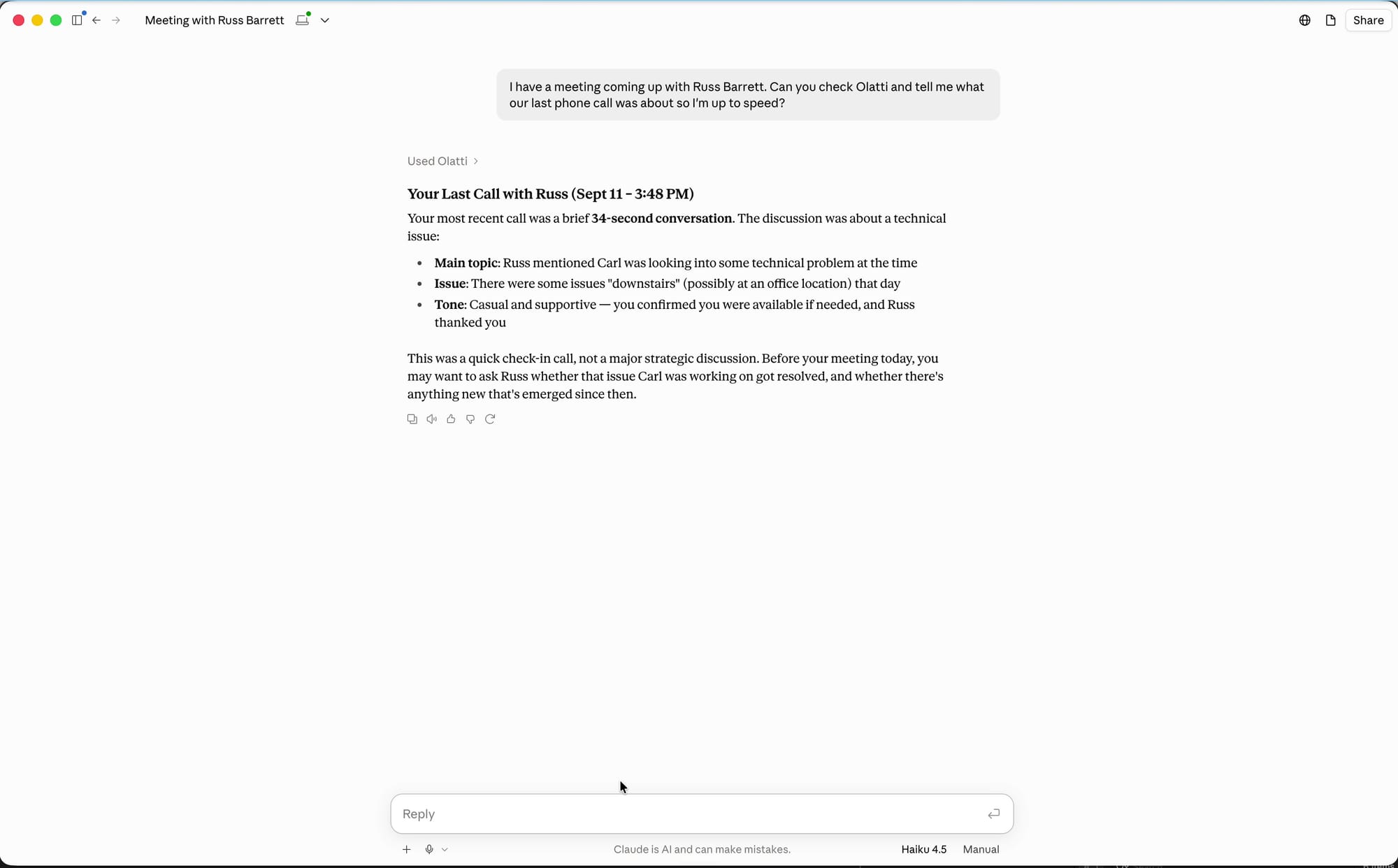
You can also just talk to it. Say "call John", and it calls John.
It works wherever you are. You get a UK number to start with and can bring your other numbers across later, so if your team is in the UK, it's a very good fit. It's live, and you can order it today.
Have a look at Olatti here.
It was oversold. Around 1,500 people last year, over 10,000 this year. There were queues from registration and queues for every room, and almost everyone I spoke to had the same complaint.
To be fair to the organisers, the CEO, Guillaume Rostand, admitted it during the event. He said they were going beyond their capacity, and they're already looking at a much bigger venue, or several, for next year.
The sessions I did get into were quite generic, with a lot of companies promoting themselves. I understand why. Most speakers apply to speak, and most of them aren't paid, so the talk is their marketing. You just go in knowing that.
The value wasn't on the stage. It was the people.
And the event had the same problem as everyone in it. The tech worked fine: the app, the QR codes on the badges, all of it. What didn't work was getting people into the room.
The question 10,000 people brought to Barcelona was: what's the right way to use AI in a business? The honest answer is that nobody knows. Not your team, not your leadership, and not me.
Here's what that looks like from the inside.
We started by giving everybody ChatGPT. Then we realised Gemini was already included in our Google Workspace, so we moved people onto Gemini. Then we found Gemini was missing things. I'd been using Claude for a while, on the desktop and in the terminal, and Claude let you connect it to your email, your calendar and your Google Drive. So we bought Claude for some people and moved them across. The rest stayed on Gemini.
Before long we had a pile of different subscriptions, different people on different tools, and no single way of doing things.
So now I'm trying something different. I'm building our own AI agent, called Coet. It connects to our company's knowledge, so anyone can ask it a question. It's not finished, and I haven't rolled it out.
But I put it in our Slack, and people started using it. Nobody told them it was there. They just saw it and started asking it questions.
Every time we pick a way of doing AI, a better way turns up a few months later. In a small company you can keep up with that. The bigger you get, the slower you turn, like a big ship: by the time a change has made it all the way through the company, the world outside has already moved on.
Then there are people. People who've done their job the same way for years. Changing how someone works is hard, and the longer they've worked that way, the harder it gets.
So three things compound:
We're about 150 people across my companies. Not huge, not tiny, and we feel all three. If you're running a company of 500, or 5,000, I think you're feeling it a lot more.
So what do you actually do about it? I think the answer is simple. You take the AI to where people already are.
The AI lead I spoke to is doing exactly this. His company runs on Microsoft Teams, so instead of asking everyone to learn a new AI app, he's putting the AI agents inside Teams.
It's what we're doing with Coet. Our team already talks in Slack, so that's where Coet lives. You open a chat, give the agent its instructions and its tools, and that's your agent. Nothing new to learn. Over the next year we're moving our own team onto Olatti's messaging, and Coet will live in there too.
That's why people started using it before I'd even announced it. It was already sitting where they work.
And it's the same reason we built Olatti the way we did. We didn't want you learning yet another AI tool just to understand your phone calls. So Olatti puts your calls inside the AI you already use, ChatGPT or Claude, and you just ask.
Yes. Hopefully with a lot more space. But I'd go for the people, not the stage.
If I had to sum up the summit: the pilot works and production is the hard part, agents are everywhere but a real one has to work when nobody's watching, voice AI is coming for every business that answers a phone, and the hardest part of AI isn't the AI. It's the people. The one thing I've seen work is taking the AI to where they already are.
Ten thousand people went to Barcelona to talk about AI. The hardest problem there was getting them through the door.
If you want a phone system that works with the ChatGPT or Claude you already use, have a look at Olatti.
Thanks, Axel.
Join 480+ founders and operators getting my learnings from building and running my companies, straight to your inbox.